Why Every Workout Matters: What Exercise Does for Your Body (and How to Fuel It)
What does a workout actually do for your body? Learn how strength, cardio, and HIIT pay off, and how smart nutrition fuels performance and recovery.
Quick answer
A regular workout routine strengthens your heart, muscles, and bones, improves mood and sleep, and lowers your risk of chronic disease. U.S. guidelines recommend 150 to 300 minutes of moderate cardio per week plus strength training on two or more days. Nutrition matters just as much: protein repairs muscle, carbs refuel your energy stores, and consistent meals drive results.
Let’s be honest. Most people don’t skip a workout because they don’t know exercise is good for them. They skip because they’re tired, busy, or stuck in a routine that feels like punishment, both in the gym and on the plate. Chicken, rice, broccoli, repeat. No wonder people quit.
Here’s the thing: working out isn’t just about looking good in the mirror, and eating for your goals doesn’t have to taste like cardboard. This guide breaks down what exercise actually does inside your body, how different types of training pay off in different ways, and why the food you eat around your workout decides how much of that effort you get to keep.
Why Working Out Matters More Than You Think
The Physical Activity Guidelines for Americans set the baseline. Adults should get 150 to 300 minutes a week of moderate aerobic activity (or 75 to 150 minutes of vigorous activity), plus muscle-strengthening work that hits all major muscle groups on two or more days a week. In real life, that’s about 30 minutes of movement five days a week and a couple of lifting sessions. Yet roughly 80% of U.S. adults and teens don’t get enough activity, according to the summary of those guidelines published in JAMA.
That gap matters, because the payoff is huge. A 2022 meta-analysis in the British Journal of Sports Medicine pooled 16 cohort studies and found that muscle-strengthening activity was linked to a 10% to 17% lower risk of death from all causes, heart disease, cancer, and type 2 diabetes. The biggest benefit showed up at just 30 to 60 minutes of strength work per week, and people who combined lifting with cardio did best of all. These are observational studies, so they show a strong association rather than proof, but the pattern is hard to ignore.
The benefits go beyond your body, too. A 2024 network meta-analysis in The BMJ covered 218 randomized trials and more than 14,000 people with depression. Walking or jogging, yoga, and strength training all produced meaningful drops in depressive symptoms, and the effects got stronger as intensity went up. Strength training and yoga were also the workouts people were most likely to stick with. (If you’re being treated for depression, talk with your doctor before changing your plan. Exercise works best alongside care, not instead of it.)
Short version: a workout is one of the few habits that improves how you look, feel, think, and age, all at the same time.
Different Workouts, Different Payoffs
Not every workout does the same job. The best routines mix a few types, because each one challenges your body in a different way.
Strength Training
Lifting weights, resistance bands, push-ups, and bodyweight circuits force your muscles to work harder than they’re used to. Your body responds by repairing those muscle fibers and building them back stronger. Over time, that means more lean muscle, stronger bones and connective tissue, and a better shot at holding onto muscle while you’re cutting calories. It also makes everyday life easier, like carrying every grocery bag up the stairs in one trip.
Cardio (Aerobic Training)
Brisk walking, cycling, swimming, and running train your heart and lungs to move oxygen more efficiently. Stay consistent and your endurance climbs, your resting heart rate tends to drop, and markers like blood pressure often improve. Cardio is also the easiest workout to scale. A 20-minute walk after dinner absolutely counts.
HIIT (High-Intensity Interval Training)
HIIT alternates short, all-out bursts with recovery periods. Because it’s intense, it counts toward the vigorous side of the guidelines, so you get a lot of aerobic benefit in less time. The tradeoff is that it’s demanding and burns through your stored carbohydrate fast, which makes what you eat beforehand matter even more.
Mobility, Flexibility, and Balance
Stretching, yoga, and mobility drills don’t get much hype, but they keep your joints moving well, help you lift with better form, and cut down on stiffness. The guidelines specifically recommend balance training for older adults, and anyone who has tweaked their back putting on socks knows mobility isn’t optional.
Why Nutrition Is Half the Workout
Training is the signal. Food is the material your body uses to answer it. You can follow a perfect program, but if you’re under-eating protein or running on empty, you’ll recover slower, lift weaker, and feel worse.
Protein rebuilds what you break down. Resistance training and protein both switch on muscle protein synthesis, and they work best together. The International Society of Sports Nutrition (ISSN) recommends 1.4 to 2.0 grams of protein per kilogram of body weight per day for most people who exercise. That’s roughly 0.6 to 0.9 grams per pound, or about 115 to 165 grams a day for a 180-pound lifter. ISSN also suggests spreading it out at around 20 to 40 grams per meal instead of saving it all for dinner.
Carbs are your fuel tank. Your muscles store carbohydrate as glycogen, and that’s what powers heavy sets, sprints, and HIIT. A joint position statement from the Academy of Nutrition and Dietetics, Dietitians of Canada, and the American College of Sports Medicine puts daily carb needs anywhere from 3 to 10 grams per kilogram, depending on how much and how hard you train. Lighter training days sit at the low end, while endurance athletes and people training for hours a day sit at the high end. Cutting carbs to zero might look good on paper, but it usually shows up as flat workouts and slow recovery.
Healthy fats keep the system running. Fats from eggs, avocado, nuts, olive oil, and fatty fish support hormone production and help you absorb fat-soluble vitamins. They digest slowly, so they fit better in your regular meals than right before a hard session.
Hydration ties it all together. Even mild dehydration can make a workout feel harder than it should. Drink water throughout the day, not just when you’re at the gym.
What to Eat Before and After a Workout
Before your workout, go for easy-to-digest carbs with a little protein, about one to three hours before training. You want energy without a heavy stomach. A warm bowl of cream of rice with protein stirred in, a banana with Greek yogurt, or chicken and rice (if you’ve got a couple of hours) all work.
After your workout, get protein and carbs back in. The same joint position statement recommends early protein, roughly 0.25 to 0.3 grams per kilogram (about 20 to 25 grams for a 180-pound person), along with carbohydrate to restore glycogen. You don’t need to sprint to the locker room with a shaker bottle, but a real meal within a few hours of training sets you up for the next session.
Then comes the part nobody talks about: you have to do it all again tomorrow. And the day after that.
The Real Enemy Is Boring Food (That’s Where We Come In)
Most people don’t fall off their nutrition plan because they lack information. They fall off because by week three, plain chicken and dry rice feel like a jail sentence. Consistency beats perfection every time, and nothing kills consistency faster than food you dread eating.
That’s exactly why The Flavor Gang exists. We started in a tiny kitchen, we still make everything by hand in small batches, and we built every product for the “I eat chicken six days a week” crowd.
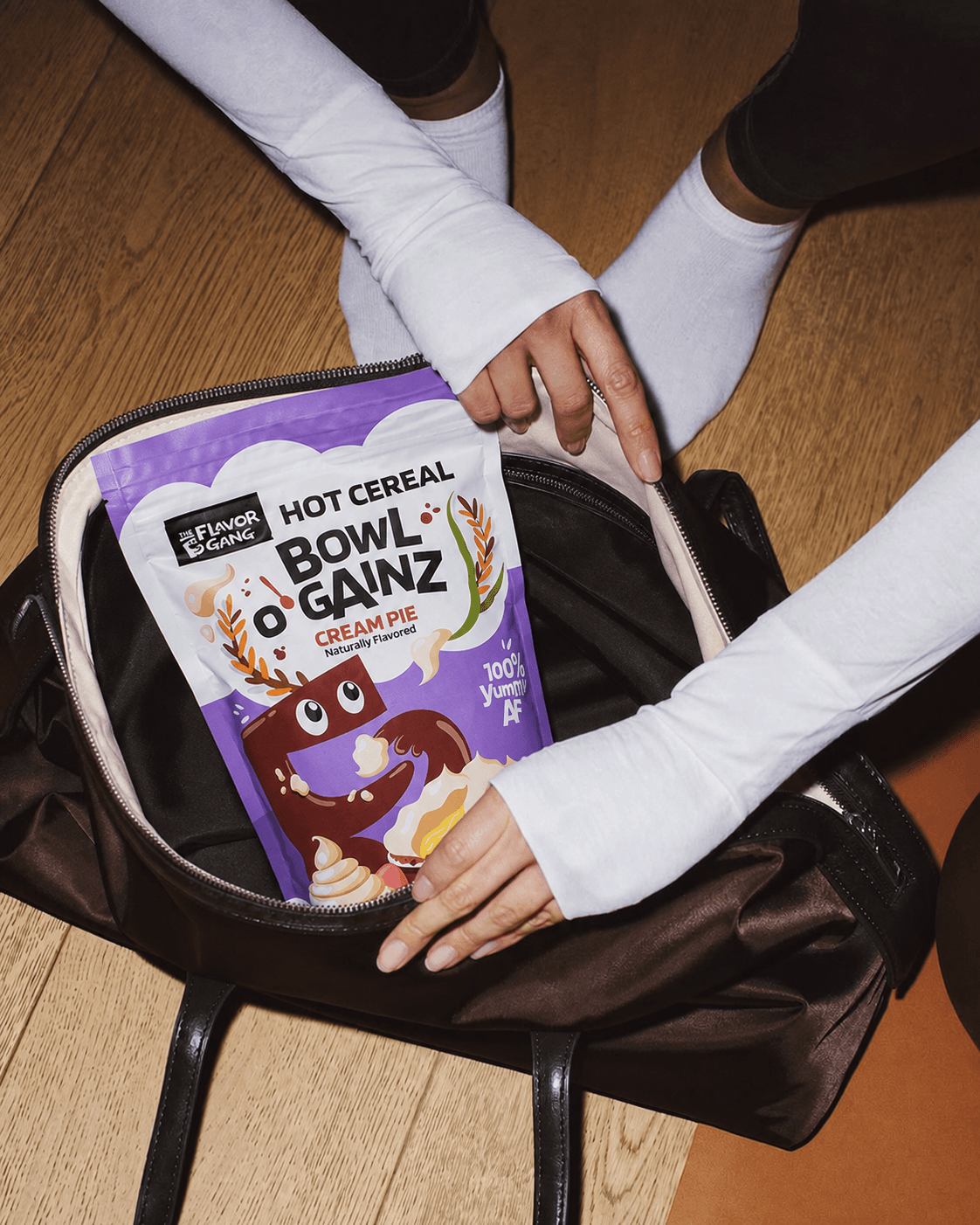
Bowl O’ Gainz (BOGz) is our flavored cream of rice, and it’s one of the easiest pre-workout carbs you can make. Cream of rice is made from finely ground rice, so it’s low in fiber and tends to sit light before training. That’s a big reason lifters have leaned on it for years. The difference is that BOGz tastes like dessert, with flavors like Brownie Batter, Peanut Butter Cookie, Crackberry, and Birthday Cake. Cook it, stir in a scoop of protein powder or whisk in some egg whites, and you’ve got a pre-workout bowl with carbs and protein that actually feels like a treat. It also makes a great base for protein pancakes when you want to switch things up.
TFG Sauces handle the rest of your day. Our low-calorie sauces make high-protein meals worth looking forward to, without turning them into a sugar bomb. Sweet Papi brings a savory-sweet hit to grilled chicken or a rice bowl. Thai Sweet-N-Nutty turns lean ground turkey and jasmine rice into a takeout-style bowl. Flavor Don’s sriracha maple heat wakes up eggs, salmon, and sweet potatoes. Same meal-prep macros, way less boredom.
A full training day might look like this: a BOGz bowl with protein before your morning lift, a chicken and rice bowl with Sweet Papi for lunch, and lean steak or salmon with roasted veggies and a sauce drizzle for dinner. That’s protein spread across the day, carbs placed around your training, and enough flavor that you’ll actually want to repeat it next week.
Consistency Is the Real Program
The best workout is the one you’ll keep doing, and the same goes for your diet. You don’t need a perfect split or a perfect meal plan. You need a routine you can repeat: a few strength sessions, some cardio, protein at every meal, carbs where they help you perform, and food that tastes good enough to come back to. Stack enough ordinary weeks together and the results stop being ordinary.

Written by Yana Capa-Pasco
Marketing Director