The Sauce Packet Is the Most Underrated Thing in Your Gym Bag
The right sauce fixes boring meal prep without wrecking your macros. Here is why single-serve sauce packets belong in your bag this summer.
Quick answer
A sauce packet is a single-serve pouch of sauce, usually around 20 grams, built for eating away from home. The best ones deliver real flavor without meaningful calories, sugar, or fat. The Flavor Gang's Lil Saucey packets run 0 to 15 calories each, contain no added sugar, need no refrigeration, and fit in a gym bag, glovebox, or carry-on.
Nobody blows their diet on chicken breast
Ask most people where their nutrition falls apart and they point at the obvious stuff. Pizza, beer, the office donuts. But audit a week of a reasonably disciplined eater and the leak is almost never the main event. It is the sauce. A standard ranch dipping cup — the 43-gram tub that shows up next to wings — carries roughly 180 calories, 19 grams of fat, and 370 milligrams of sodium. That is not a condiment. That is a snack with a lid on it, and it almost never makes the food log, because nobody thinks of ranch as food.
The second leak is the pour. Bottled sauces build their nutrition panel around one or two tablespoons, a measurement almost nobody respects when the bottle is in hand and the chicken is dry. Real pours tend to run about double what the label assumes, which means the number on the back was optimistic before you sat down. The calories were never the problem. The uncounted calories were.
But cutting sauce is the wrong fix
The instinct here is to go dry. Plain chicken, plain rice, plain broccoli, no sauce, no problem. It works for about a week and a half. There is real science under why it stops working: researchers call it sensory-specific satiety, the measurable drop in how much you enjoy a food while you are eating it, even as untouched foods stay just as appealing. Stretch that across weeks of identical meals and it becomes monotony — a slow erosion of how much you like the food you committed to. Adherence rarely collapses in a dramatic moment. It erodes.
The research runs the other way too, and it is worth being honest about it. Variety inside a single meal reliably makes people eat more; in one well-known study, adding condiments to a food participants had been eating plain essentially reset their appetite for it. That is why buffets work, and it is a real consideration.
So the move is not more variety. It is variety in the right place. Keep the food monotonous — same lean protein, same measured rice, same vegetables, same predictable macros you can log half-asleep. Then rotate the flavor sitting on top of it. You get the novelty that keeps you interested without the calorie bill variety usually carries. A 20-gram packet at zero to fifteen calories is, in the most literal sense, novelty that costs nothing.
Why this matters most right now
Summer is the season that quietly undoes people. Researchers at the University of Georgia tracked 122 adults through vacations of one to three weeks taken between March and August. Sixty-one percent gained weight, averaging about seven-tenths of a pound on the trip — and the gain was still there six weeks later. Some participants gained as much as seven pounds. Set that against the one to two pounds the average adult gains in an entire year and the trip did most of the year's damage in ten days, quietly enough that nobody noticed.
The mechanics are familiar. Your kitchen is not with you. The hotel has a mini fridge and a microwave. The cooler has grilled chicken you packed Sunday and stopped wanting by Tuesday. The gas station has jerky and a wall of candy. The cookout has three sides you did not choose. In every one of those moments the food is either fine and boring or interesting and untracked, and boring loses that fight almost every time. A sauce packet does not solve summer. It solves the twenty seconds where the boring option becomes the interesting one — which is where the drift actually happens.
What separates a real sauce packet from a ketchup packet
Single-serve condiments are not new; fast food has handed them out for fifty years. What is new is a packet built for someone who is actually tracking. Four things are worth checking before you buy:
- The packet is the serving. No measuring, no eyeballing. The portion decision is made before you tear it open, which removes the biggest source of error in condiment tracking.
- Shelf-stable until opened. If it needs a cooler, it did not solve the travel problem. It relocated it.
- Same recipe as the bottle. Plenty of portable formats are watered-down versions of the real product. If it does not taste like the bottle, it will not get used twice.
- A label that survives scrutiny. Calories, sugar, and sodium printed plainly, at a serving size matching what you will actually eat.
Most single-serve sauce clears one or two of these. Very little clears all four, mostly because sauces built for portability were designed for restaurants, and sauces built for macros were designed for a shelf in your fridge.
Inside the Lil Saucey lineup
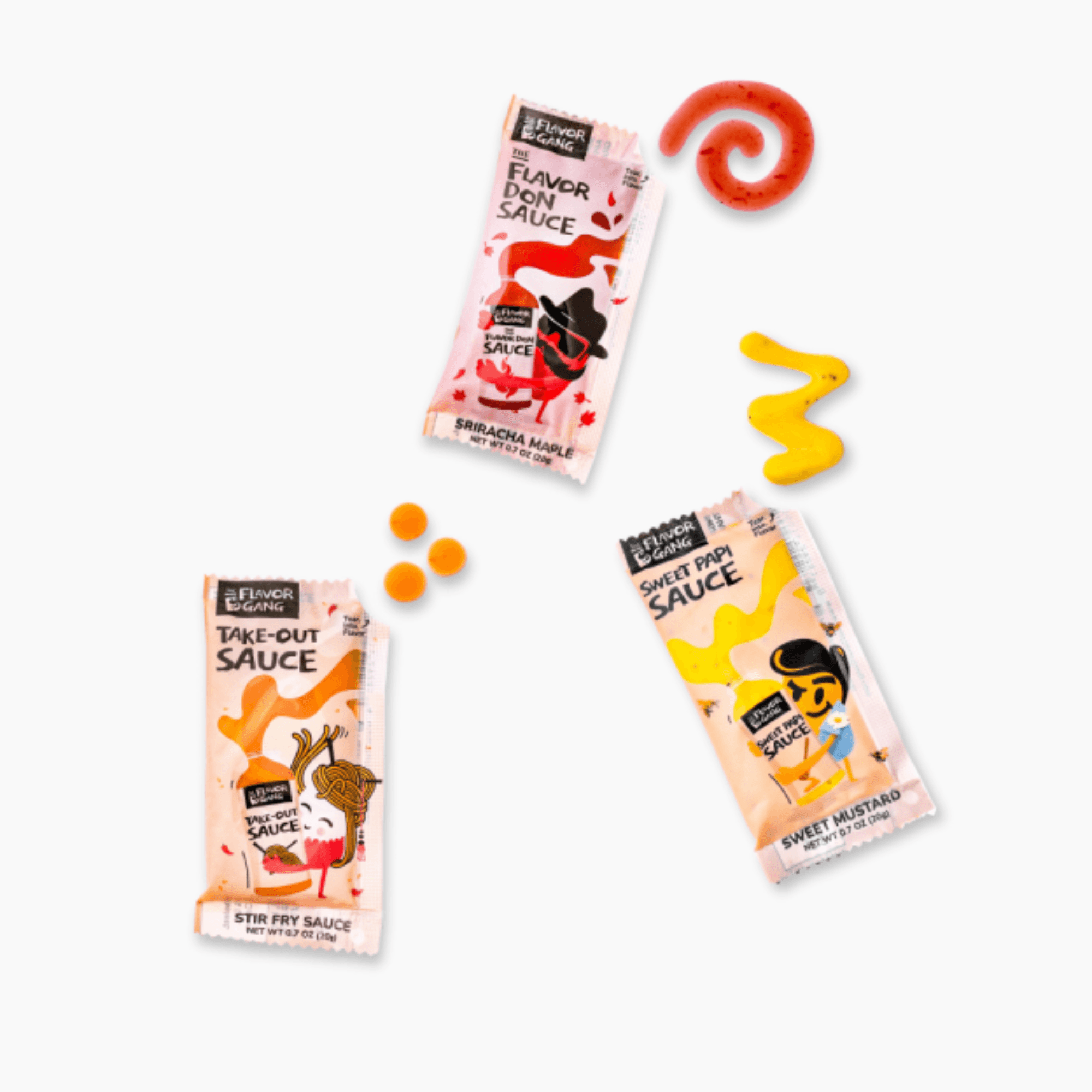
The Flavor Gang built Lil Saucey to close that gap: the same small-batch recipes we make in Gonzales, Texas, packed into a 0.7 oz (20 g) pouch that goes anywhere. Three flavors, and all three carry zero added sugar.
The Flavor Don (Sriracha Maple) — 0 calories. Maple smoothness up front, sriracha on the finish, not so hot it takes over the meal. Turns an egg-white scramble or a hotel-microwave chicken breast into something you finish on purpose. Zero fat, zero carbs, zero sugar, roughly 85 mg sodium.
Take-Out (Stir Fry) — 5 calories. Savory, faintly sweet, straight take-out energy without the sodium load and sugar that come standard in bottled stir-fry and teriyaki sauces. Rice, chicken, frozen veg, one packet, done. Zero fat, zero carbs, zero sugar, roughly 95 mg sodium.
Sweet Papi (Sweet Mustard) — 15 calories. The closest thing in the lineup to a classic dipping sauce: smooth mustard bite, real poppy seeds, turmeric and paprika carrying the depth. Your answer when dry chicken is not an option and honey mustard would cost you 45 calories and a pile of sugar. 1 g fat, 2 g carbs, zero sugar, roughly 170 mg sodium.
Carry all three and you have covered savory, sweet-heat, and tangy — functionally every lane a chicken-rice-vegetable rotation needs. That is the rotation strategy in a form that fits in a pocket.
How to actually use them
The packets earn their keep in the moments where your kitchen is not available and your standards are about to slip:
- Meal prep insurance — pack the containers plain on Sunday, decide the flavor at lunch. Same prep, different meal, five days running.
- Travel meals — a grocery-store rotisserie chicken and a microwave rice pouch become dinner instead of a compromise.
- Restaurant control — order the protein plain and sauce it yourself. You skip the kitchen's butter finish and know exactly what hit the plate.
- Cookouts — dress your own plate instead of taking whatever is already glazed in sugar.
One habit worth building: keep two or three flavors in rotation rather than one. The point is giving your palate something it did not have yesterday, so the food you built your week around stays worth eating.

Written by Yana Capa-Pasco
Marketing Director