Cream Pie, Deconstructed: The Dessert That Was Never About the Cream
What makes a cream pie taste creamy? The food science behind it, and how Bowl O' Gainz Cream Pie delivers that velvety flavor at 110 calories and 0g sugar.
Quick answer
A cream pie is a dessert pie filled with a thick, sweet custard or pudding and usually topped with whipped cream. Its signature velvety texture comes from gelatinized starch, not just dairy fat, which is why The Flavor Gang's Bowl O' Gainz Cream Pie can hit that same creamy, sweet, spoon-coating flavor at 110 calories, 0g fat, and 0g sugar per serving.
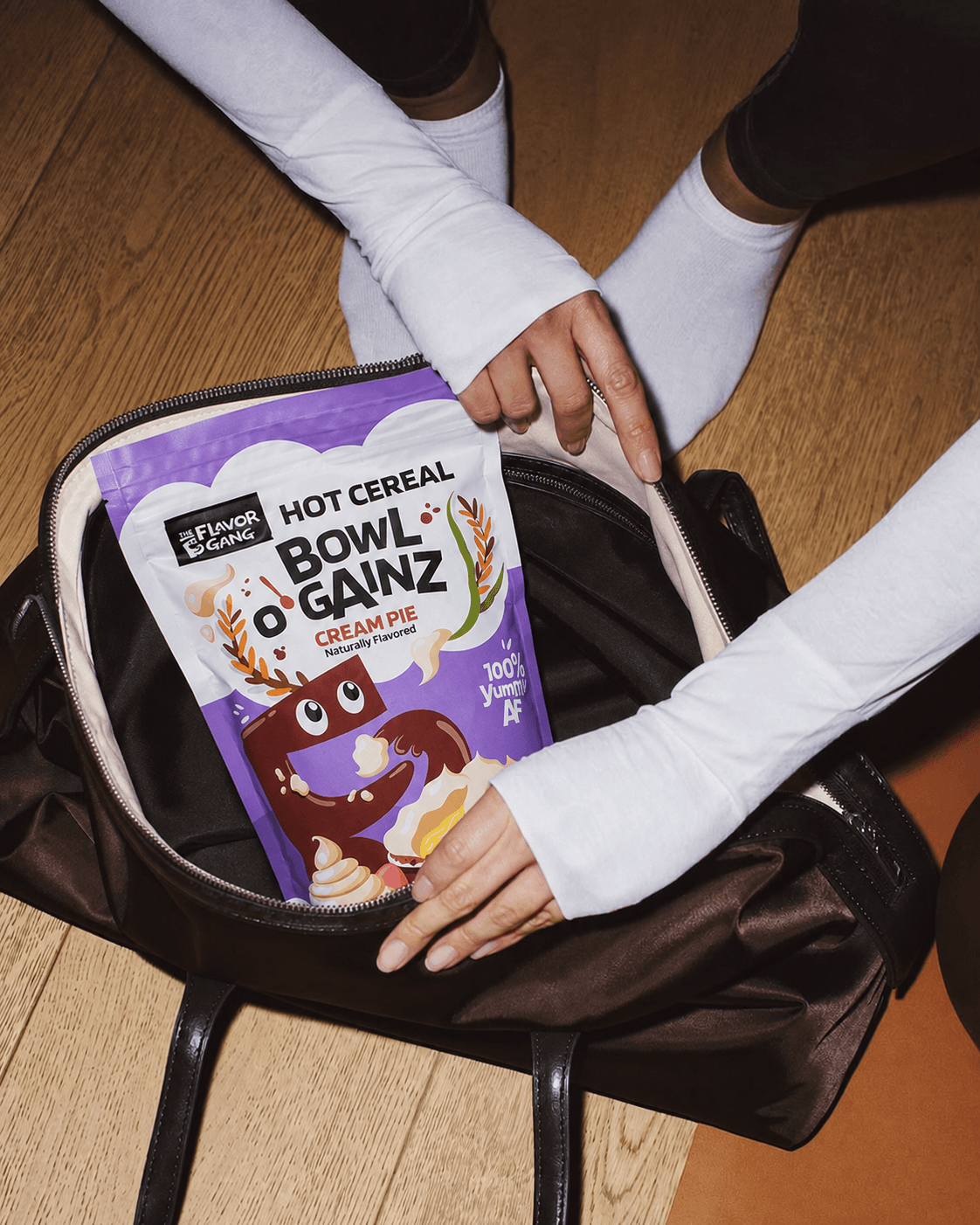
There is a specific kind of disappointment that comes with dieting. It is not hunger. Hunger you can manage. It is the moment you look down at a bowl of plain cream of rice at 5:30 in the morning, gray and gluey, and realize you have twelve more weeks of this. That is the moment most people quit. Not because the plan was wrong, but because the food was boring.
So let's talk about cream pie. Not as a cheat meal you are trying to earn, but as a flavor profile worth understanding, because once you know why a cream pie tastes the way it does, you can build that same experience into a bowl that actually fits your numbers.
What a cream pie actually is
A cream pie is a pie filled with a rich custard or pudding built from milk, cream, sugar, flour, and eggs, then usually finished with whipped cream on top. The term shows up in print as far back as the 1810s. From there it branched into the whole family everyone knows: banana, coconut, chocolate, lemon, peanut butter, and plain old vanilla.
The history is messier and more interesting than the menu suggests. Boston cream pie, invented around 1856 at Boston's Parker House Hotel, is not a pie at all. It is sponge cake with custard between the layers. It picked up the name because in the mid-1800s cakes and pies were baked in the same tins and the words were used more or less interchangeably. Meanwhile, out in Indiana, sugar cream pie has been made since the state's founding in 1816 with nothing but cream, sugar, and cornstarch. No eggs. It earned the nickname "desperation pie" because you could make it from whatever was already in the pantry when the fruit ran out.
That is the thread worth pulling. Cream pie was never a luxury dessert built on expensive ingredients. It was a technique for turning cheap staples into something that felt indulgent. Which is exactly the problem every person tracking macros is trying to solve.
The secret ingredient isn't cream. It's starch.
Ask most people what makes a cream pie creamy and they will say fat. Fat is part of it, but it is not the mechanism. The mechanism is starch gelatinization.
Here is what happens in a pot of pastry cream. Starch granules from the flour or cornstarch sit in the liquid doing nothing until heat arrives. As the temperature climbs, those granules absorb water and swell, dramatically increasing the viscosity of everything around them. The liquid goes from thin to thick to spoon-coating. That swelling is why the filling sets. It is why the slice holds its shape.
And it turns out that swelling does something else. Food scientists studying mouthfeel have found that rheology alone, meaning thickness, does not fully explain why something reads as creamy. The bigger driver is oral tribology, the friction between your tongue and the roof of your mouth as you press the food. Creaminess, smoothness, and slipperiness track with how well a food lubricates that contact. Swollen starch granules lubricate extremely well. That is precisely why the food industry uses starch as a fat replacer in low-fat dressings, sauces, and baked goods, and why those products can taste rich while carrying a fraction of the fat.
Which brings us to the point. Cream of rice is finely milled white rice, which is to say it is almost entirely starch. Add water, add heat, and you run the exact same reaction that thickens a cream pie filling. The granules swell, the mixture turns velvety, and your tongue reads it as creamy. Not as a substitute for the real thing. As the same physics.
Why it tastes sweet when the label says 0g sugar
The second half of a cream pie is aroma, and this is where the research gets genuinely useful for anyone eating in a deficit.
There is a well-documented effect called odor-induced sweetness enhancement. Certain aromas make food taste sweeter without adding a single gram of sugar, because your brain has spent a lifetime encountering those smells alongside sweet things and now fuses the two. Vanilla is the strongest performer in the category. When researchers screened sweet-congruent aromas against honey, banana, raspberry, and elderflower, vanilla came out on top. In one study, adding vanilla aroma to a low-sugar yogurt let the formulators cut sugar by a quarter with no drop in acceptability.
Now here is the part that matters specifically for a rice-based cereal. In work on plant-based yogurts, vanilla aroma did two things at once: it pushed perceived sweetness up, and it actively suppressed the grain-like flavor of the base. That grainy note is the exact thing that makes plain cream of rice taste like wallpaper paste. A vanilla-forward cream pie profile does not just decorate the bowl. It cancels out the one flavor you were trying to escape.
So a bowl with zero grams of sugar can still land as sweet, creamy, and dessert-like. Not a trick. Just how flavor perception works.
Bowl O' Gainz Cream Pie: sweet, and not salty
The line on the back of the bag reads: finally, a cream pie that is sweet and not salty. That is a joke, and it is also literally true on the panel. Cream Pie carries 0mg of sodium.
Here is what a serving actually looks like. One serving is 2.5 tablespoons, or 32 grams, and a bag holds about 21 of them.
- 110 calories per serving
- 25g carbohydrate, with 0g total sugars and 0g added sugars
- 0g fat — no total, saturated, or trans
- 2g protein
- 0mg sodium, 0mg cholesterol
- 6% DV iron, 30mg potassium
- Three ingredients: granulated rice, natural flavor, sucralose
We are going to be straight with you about that 2g of protein, because plenty of brands in this space are not. Cream Pie is a carbohydrate. It is a clean, fast, easy-to-track carbohydrate that happens to taste like dessert, and that is the whole job. It is not a protein source and it is not pretending to be one. You build the protein on top of it. That is not a weakness in the product; it is what makes it flexible enough to slot into whatever your day actually needs.
Cook it right, or you'll blame the wrong thing
Most bad bowls of cream of rice are a technique problem, not a product problem. People dump, microwave once, hit a wall of lumps, and decide the flavor is bad. The lumps are the flavor problem. A clumped bowl has pockets of dry powder that never gelatinized, which means they never got creamy and never released aroma.
The ratio is 4 grams of water for every 1 gram of mix. For a standard 32g serving, that is about 128g of water, a bit over half a cup. Use a microwave-safe bowl roughly 4 to 5 inches across and about 3 inches tall. Too wide or too shallow and the mixture spreads thin and cooks unevenly; too tall and it boils over.
Cook it in stages. Ninety seconds first, then pull it out and stir, using the back of a metal spoon or a whisk to smash any clumps against the side of the bowl for fifteen to thirty seconds. Another sixty seconds, stir and smash again. Repeat until it is smooth, then give it a final thirty seconds. Do not rush the process. The stirring between rounds is where the texture is made.
Building the bowl
Cream Pie is a base flavor, which is its real advantage. Bold flavors are exciting for a week and exhausting by week three. A clean vanilla-cream profile is the one you can eat five days running and still want on Saturday, and it takes toppings without fighting them.
For protein, stir your powder in after cooking rather than before. Whey can seize and go grainy under direct microwave heat; folded into an already-hot bowl it stays smooth. Egg whites cooked in during the last round will set the bowl into something much closer to an actual custard, which is a good trick if you are chasing the real cream pie texture. Greek yogurt folded in cold works too and pushes it toward a cheesecake direction.
For toppings, the bag says it plainly: add berries or nut butter and you are good. Sliced banana and a pinch of salt turns it into banana cream pie, which is where this flavor family started anyway. Coconut flakes take it to coconut cream. If you want the full effect, a crushed graham cracker on top is maybe 60 calories and gives you the crust note your brain is looking for.
On timing: as a fast-digesting, low-fiber, low-fat carb, cream of rice sits well close to training. Most lifters run it 60 to 90 minutes before a session, or immediately after with a protein source to help reload glycogen. It is also useful when appetite is low but you still owe your body food, which is most of prep.
And it is not locked to a bowl. Mixed with egg whites it makes protein pancakes and waffles. It bakes into muffins. The pack itself points you at Plain Jane if you want to build your own flavor from scratch, but Cream Pie is the one to reach for when you want the work already done.

Written by Yana Capa-Pasco
Marketing Director